Archive for category Reflections
Chip – Conception to The Public Release
Posted by Robert Meyer in Design, Reflections on July 8, 2012
Sometime in 2010 a professor recommended I look into the Flixel library for Flash when I expressed to him both my interest in making a game and my complete lack of technical skills. I had almost no programming experience whatsoever.
However, given that piece of advice I decided to dive in. Below is a quick overview of the process that ensued before I ended up with this game Chip that I recently “released.”
After installing FlashBuilder (as I work on a Mac this was my only option), I started with the Flixel Hello World tutorial. This great resource talks you through setting up your Flixel Project for the first time, which can be overly intimidating due to small annoyances such as the need for a blank Default.css file and the additional compiler arguments you need to go with it in order to get the Flixel Preloader to run. (This may be fixed in a new version, but I still use flixel 2.34).

Some of my favorite games from 2011
Posted by Robert Meyer in Reflections on December 31, 2011
by Bennett Foddy
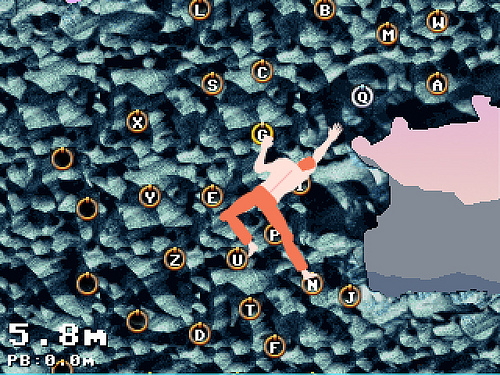
Girp is simply one of the most interesting physics games I’ve ever played. The controls and use of the keyboard are innovative and personally inspiring. I played this game side-by-side with a friend who had never seen it before this week, and we both laughed and gasped as we finally were able to reach that next letter, which seemed utterly impossible only seconds before. A game that’s both rewarding, silly, and will cause you to exert a tremendous amount of force onto your keyboard is well worth this spot at the top of my list.
On “Gravitation”
Posted by Robert Meyer in Reflections on August 15, 2011
“Jason Rohrer is the Mark Rothko of videogames and he has come to destroy us all.” Those are the words one of my closest friends (and the artist for my flash game Chip) said to me after playing Passage for the first time. He is an educated artist, who suffice it to say, strongly dislikes 90% of everything that is labeled as modern art. He probably dislikes the term “modern art” most of all. Anyways, when he said this to me, I somewhat agreed. I’ve had a love/hate relationship with art games over the past year or two. I find I Can Hold My Breath Forever and I Wish I Were The Moon painfully pretentious and contrived attempts at an “art game,” while I adore Small Worlds and The Company of Myself. Passage felt like too much of an attempt at an artistic statement, and too little of a game. At the same time, it’s somewhat charming and interesting for what it does, even if it’s simply a “meditation” on actual games and/or life. Regardless, this post is not about Passage, it’s about Gravitation, which I find infinitely more interesting.
On “Every Day the Same Dream”
Posted by Robert Meyer in Reflections on August 5, 2011
A definitive quality of most games is that they present to the player some freedom in which to make interesting decisions. Narrative choices, however, seem to have a limited range of effects in modern videogames. Many choices appear unsubstantial; creating a façade of freedom that always leads to the same outcome. Other games scatter choices across the story in order to trigger one in a handful of alternate endings; Chrono Trigger for example. Finally, games like Mass Effect do their best to morph the story world and character reactions to the seemingly endless barrage of dialogue-based choices the player must endure. However, what happens when a narrative game becomes not about what the choices result in, but about the process of making the choices itself? In Every Day the Same Dream, a brief 10-minute flash game by Paolo Pedercini, the player’s journey through making the different choices in the game’s small world is essentially the entirety of the gameplay experience.
Play begins with the unremarkable character awakening from bed into a black, white and grey world. In the first screen he is presented with two immediate choices. He can turn the alarm off or not, and he can get dressed or not. Either way he then proceeds to the next screen where he can turn off the TV or not, and a few screens later he has the option to walk left or right. This goes on for another handful of screens. The player must select their way down the game’s decision tree until eventually it resets and starts the player over in the bedroom again. A woman in the elevator of your building hints that you have X amount of steps to take on your way to becoming a new man, and the player eventually puts together that this means exploring the various different possibility trees the game has to offer.